On-Model Knitwear Photography Without a Photoshoot: Texture, Drape, and What Goes Wrong
The Short Answer
With knitwear the material is the product. Two things have to survive into the finished image: the stitch structure at a legible scale, and where the hem sits relative to the waistband. Colour and styling are easy by comparison. A sweater photographed so that neither the gauge nor the length is readable is a picture of a colour, and colours get returned.
What Makes Knitwear Hard
- Texture is the differentiator. Rib, cable, seed stitch, purl, waffle — the structure is what separates a basic sweater from a premium one. It is also the first thing lost to compression, soft light and small crops.
- Brushed yarns have a halo. Mohair, alpaca and brushed lambswool carry a fuzzy outline that reads as softness. Flatten it and the garment looks cheap even when the colour is perfect.
- Melange is a fibre blend, not a colour. Heather grey is made of differently dyed fibres. Rendered as a flat grey it stops looking like wool.
- Knits move and settle. The same sweater reads boxy or fitted depending on how it hangs, so an oversized or drop-shoulder cut has to be stated rather than assumed.
- The hem is a size signal. Cropped, regular and longline differ by centimetres and are told apart only by whether the hem sits above, at, or below the waistband of the trousers.
The Three Mistakes We See Most Often
1. Treating texture as if it were colour
If every reference you supply is a full-length view, nothing in the input carries the stitch at a resolution the model can work from. GridShot has a dedicated slot for exactly this: context images typed as material, fit, detail or colour, mapped to the article and distributed round-robin so that no single garment in an outfit eats the whole reference budget. For knitwear, one close-up of the knit is worth more than three more full-length shots.
2. Leaving the length unstated
Cropped knitwear that gets rendered hip-length is the single most common category error we see. Length and fit follow a cascade: values curated on the article count as brand truth and appear in the prompt as binding, and only where none exist does the AI-detected value take over in a softer tone. Curated fields are never auto-filled by the analysis, so this is a deliberate act by your team — and for knitwear it is worth doing.
3. Poses that hide the front
Hands in pockets, folded arms and half-turns are flattering and they destroy exactly what a knit buyer inspects: the button placket, the hem line, the shoulder seam. Keep at least one pose with both arms clear of the body.
The Views You Actually Need
| View | What it answers for knitwear | Typical slot |
|---|---|---|
| Full-length front | Hem position against the waistband, overall volume | Main image, catalogue view |
| Bust or upper-body view | Neckline, shoulder line, stitch at a legible scale | Mandatory on some marketplaces |
| Back | Yoke, back length, whether the cut drops at the rear | Alternate |
| Side | Sleeve length, how the body hangs away from the torso | Alternate |
| Stitch macro | Gauge, structure, halo, melange | Alternate, and the one that sells |
| Cardigan open and closed | Placket, button count and spacing, layering behaviour | Alternate for cardigans |
The bust view is not a nice-to-have everywhere: About You asks for a bust view alongside the model view, which happens to be the requirement best aligned with what knitwear actually needs. The formats, ratios and rejection handling are covered in the About You image requirements and, across platforms, in the marketplace image requirements overview. How many images per article make sense before the returns curve stops moving is a separate question, handled in how many product photos per SKU.
Three of Our Own Results, With Commentary
All three were generated with GridShot. We picked them because each one shows a different part of the knitwear problem, including where it is not solved.
Coarse gauge, clean light
AI-generated with GridShot.
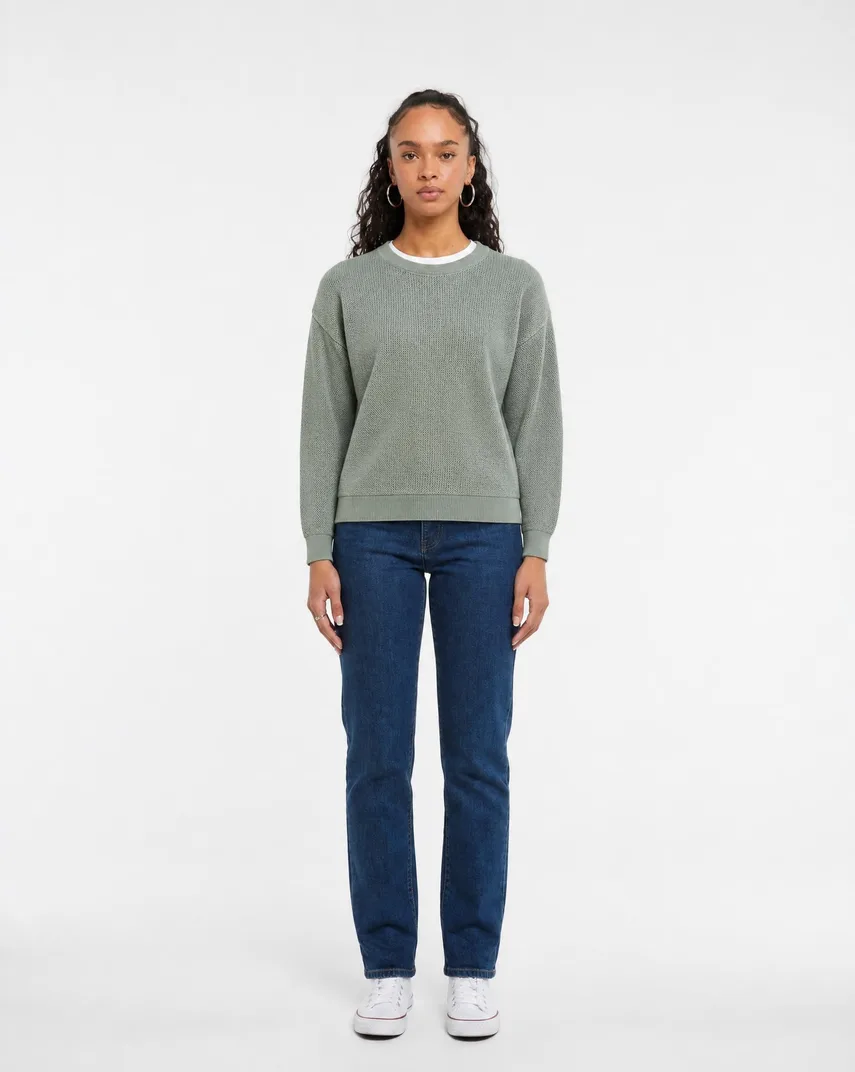
This is close to the best case for a knit. The gauge is coarse enough that individual loops survive at full-length scale, the ribbed cuffs and hem read as a different structure from the body, and the drop shoulder is visible as a seam sitting well down the upper arm. The hem stops just above the jeans waistband, which is the length information a buyer needs. Even here, we would still ship a photographed macro alongside it — at this distance you can see that the knit is coarse, but not what the yarn is.
Brushed yarn against a hard background
AI-generated with GridShot.
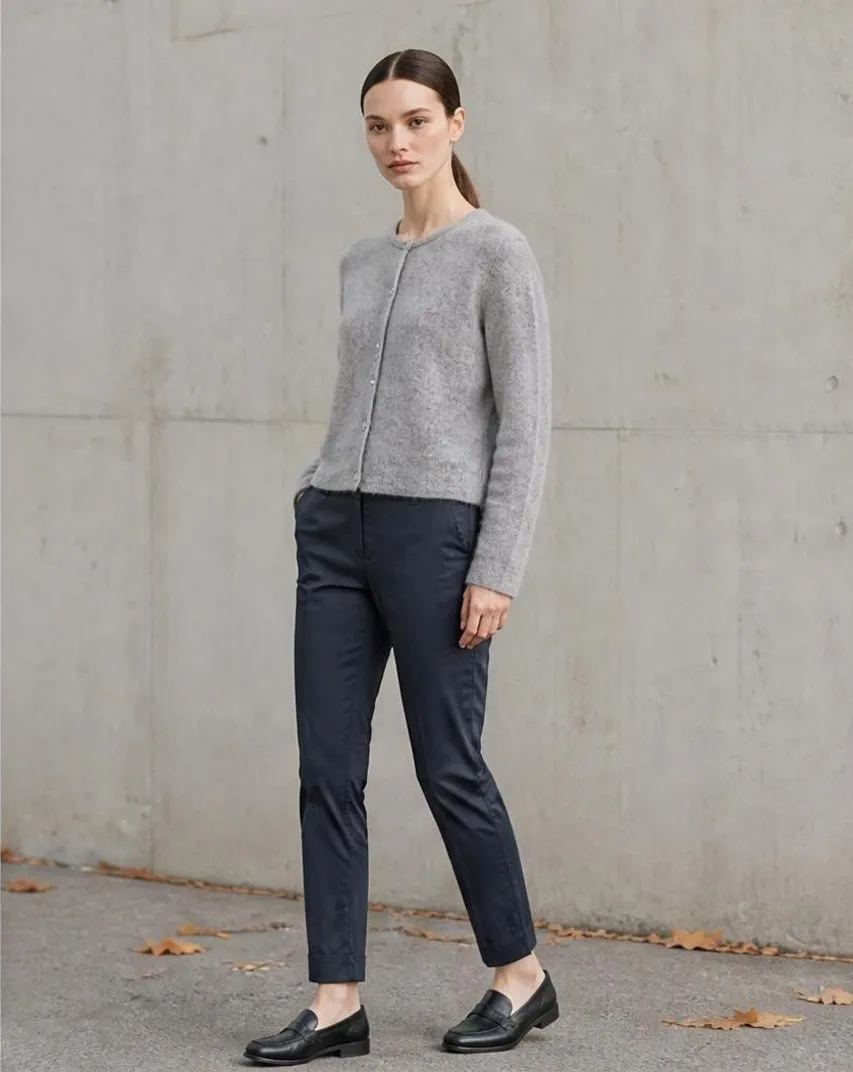
The halo is the point of this image: against flat concrete the brushed fibres separate from the background and the cardigan reads as soft rather than as grey fabric. The buttons are small, evenly spaced and follow the placket correctly, which is not guaranteed. And the honest flaw is in the pose — the hand in the pocket pulls the lower front open and lifts one side of the hem, so this frame cannot be used to judge where the cardigan ends. That is why it is a second image, not the main one.
The same cardigan in low light
AI-generated with GridShot.
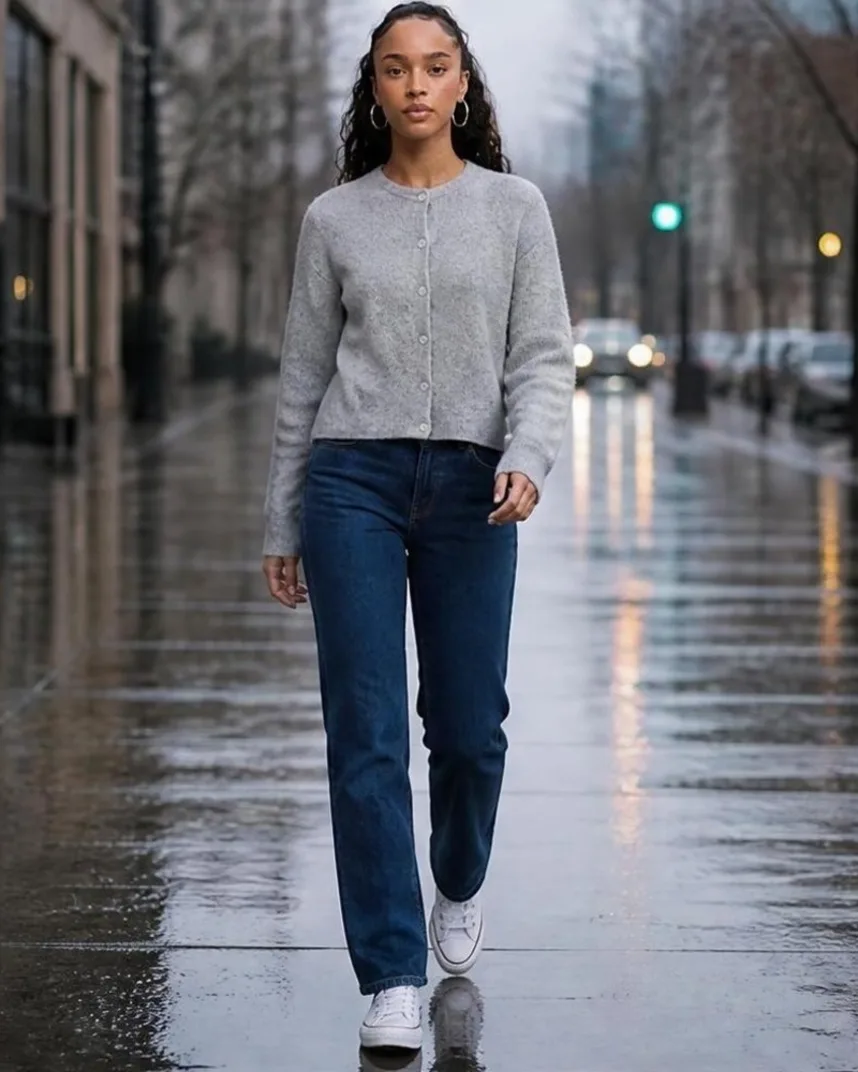
A lifestyle scene, and a useful warning. The cut, the button row and the cropped length above the waistband are all clear, and the wet street gives the image atmosphere a studio cannot. But compare the surface with the previous image: in flat, overcast light the halo collapses and the cardigan moves toward looking like a smooth jersey. Low-light scenes are for the campaign slots and the social crops. Texture gets sold on a bright frame.
Where AI Knitwear Still Fails Today
- Very fine gauge smooths out. Coarse knits survive; a fine-gauge merino tends to render as a soft matte surface rather than as loops. If fine gauge is your product, plan on photographing the macro.
- Cable repeats drift. Complex cables, Aran panels and jacquard motifs can change their repeat or wander across the body between variations. Compare a generated cable against the reference before publishing.
- Melange flattens. Heathered yarns lose some of their fibre mix and move toward a single tone. Keep a photographed colour reference in the gallery for melange articles.
- Button counts are not a guarantee. Placket details are small; a cardigan can come back with a button too many or too few. This is a checking task, not a prompting task.
- Back-side artwork can land on the front. Intarsia motifs and back logos sometimes appear on the wrong side of the garment. Every back view needs a human look.
- Hand feel is not photographable at all. Weight, warmth, itch and pilling behaviour are what the return is about, and no image of any origin conveys them. Description text and material data carry that load.
Related Category Guides
Different category, different failure mode: jeans photography, where the hem break and the leg opening decide everything, and shorts photography, where the inseam is the whole purchase. If you want to see the range before trying it, the examples page collects finished output, and the photoshoot alternative page explains how a run works end to end.
Frequently Asked Questions
Which reference photo matters most for knitwear?
A close-up of the knit itself. In GridShot that goes in as a context image typed as material, which is prioritised alongside the primary product view rather than competing with it. Without it, the only structural information in the request is whatever survives in a full-length photograph, which for anything finer than a chunky gauge is close to nothing.
Can AI reproduce the real stitch structure of a knit?
For coarse and medium gauges, convincingly: rib, seed stitch and chunky knits come through as structure rather than as texture noise. Very fine gauges tend to smooth toward a flat surface, and complex cables can shift their repeat. The reliable division of labour is generated on-model views for fit and styling, one photographed macro for the material claim.
How do I stop a cropped sweater from being rendered hip-length?
By curating the length on the article instead of leaving it to the analysis. Curated values are treated as brand truth and enter the prompt as binding instructions, while an AI-detected value is used only as a softer preservation signal. It takes seconds per article in the product drawer, and cropped knitwear is the category where skipping it shows up most visibly.
Do I still need a photographer for knitwear?
For macro shots of the yarn, yes, and it is worth it. Everything above the macro — on-model front, back, side, colourway variants, seasonal restyling — is where generation carries the volume. Most knitwear brands end up with a small photographed core of material images that stays valid for years, plus generated model imagery that gets refreshed every season.
Which views does a sweater need on a product page?
Full-length front for hem position, an upper-body view for neckline and shoulder line, a back view, and one stitch macro. Cardigans need one more, shown open, because the placket and the way it layers are the reason someone buys a cardigan instead of a pullover. Anything beyond that is styling, not information.
Ready to try it yourself?
Start with your own garment photos. Image generation is charged to your GridShot balance.
Create an account