On-Model Shorts Photography Without a Photoshoot: Length, Rise, and What Goes Wrong
The Short Answer
Shorts are bought on length. Between a short chino, a mid-length and a bermuda lie a few centimetres of inseam, and the only thing that makes those centimetres visible is the hem seen in relation to the knee. Every framing and pose decision for this category follows from that one sentence. Rise comes second, everything else third.
What Makes Shorts Hard
- The length classes sit close together. Three products that differ by four centimetres look identical in a cropped frame and completely different on a body. There is no other category where so much depends on so little distance.
- The reference edge is the knee, and it moves. On trousers the hem meets the shoe, a fixed landmark. On shorts the only landmark is a joint that changes position with every pose.
- Rise and length interact. A high rise on the same inseam reads as longer, because the whole garment sits further up. Neither value means much without the other.
- Cuffed hems are a construction detail that vanishes. Turn-ups, raw edges and finished hems are visually similar at full-length scale and very different in the hand.
- Pale summer fabrics blow out. White and pastel shorts under strong light lose exactly the edges — cuff, seam, pocket opening — that carry the detail.
The Three Mistakes We See Most Often
1. Cropping at mid-thigh
A frame that ends above the hem removes the product. It sounds too obvious to state, and it is one of the most common shorts images on the internet. Shoot and generate head to toe; a detail crop is a second image, never the first. In practice this is also a format decision — portrait proportions keep the full leg in frame, square ones push toward a torso crop.
2. Using a seated pose as length evidence
Seated, cross-legged and steps poses ride the hem up the thigh and fold the fabric. They make beautiful campaign images and they are useless for judging inseam. If a seated shot is your hero, the standing full-length view has to sit right next to it.
3. Leaving length and fit unstated
As with every category, the length and fit values on the article decide what the prompt is allowed to assume. Curated values entered by your team count as brand truth and are phrased as binding; where they are missing, the AI-detected value takes over in a softer tone. Note the deliberate asymmetry: GridShot never fills the curated fields automatically, because a confidently wrong length is worse for shorts than an unstated one.
The Views You Actually Need
| View | What it answers for shorts | Typical slot |
|---|---|---|
| Full-length front, standing | Inseam relative to the knee, rise, overall volume | Main image, catalogue view |
| Full-length back | Seat fit, back pockets, whether the back rise sits higher | Alternate, and the returns lever |
| Side | Leg opening, how far the hem stands away from the thigh | Alternate |
| Waistband detail | Belt loops, closure, drawcord or elastic back | Alternate |
| Hem or cuff detail | Turn-up versus raw versus finished hem | Alternate |
Which of these are mandatory depends on the channel, and not every channel says so out loud. Zalando and Amazon publish concrete specifications; Otto does not publish a binding public image specification at all, which means the requirement arrives through your own account and account manager instead — the practical way to plan around that is in Otto product image requirements, and the cross-platform comparison is in the marketplace image requirements overview. Marketplace crops and export formats are a step after generation, not a property of the generated image.
Three of Our Own Results, With Commentary
All three were generated with GridShot. The middle one is included precisely because it is the wrong image for a product page.
Standing, full length — the usable one
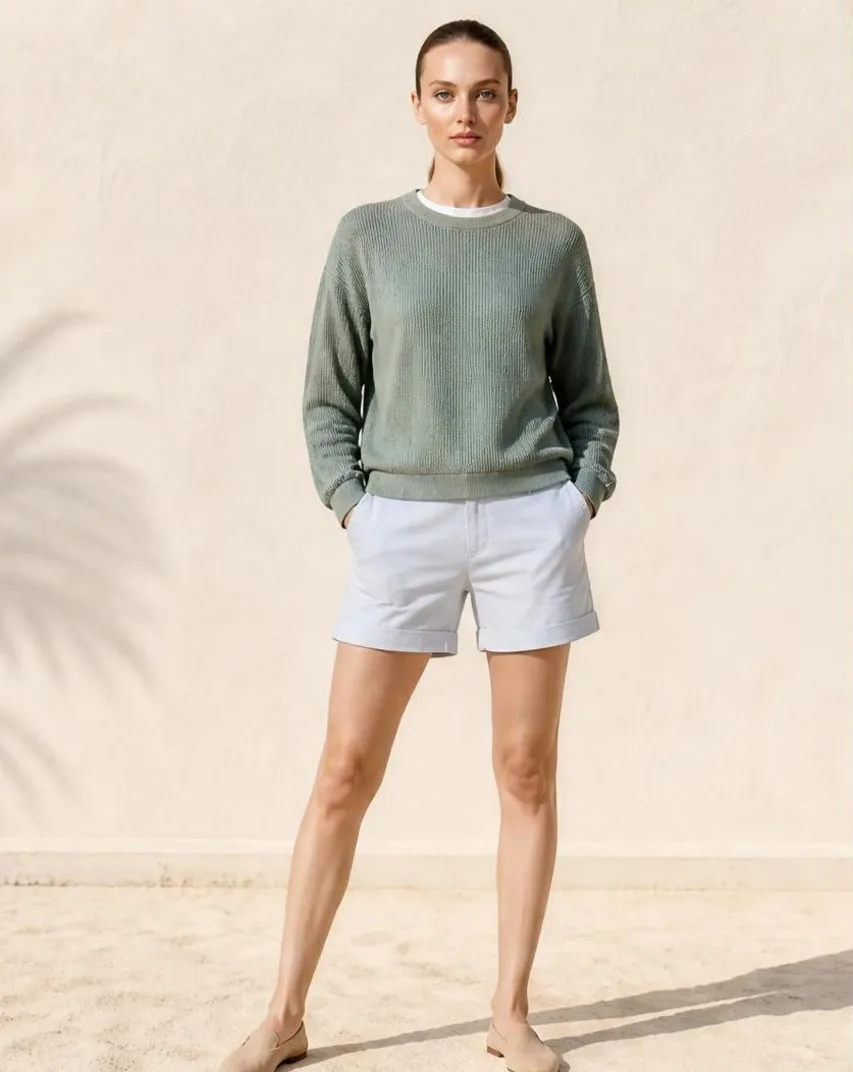
AI-generated with GridShot.
The hem sits clearly above the knee with room to spare, and the turn-up cuff is visible as a separate band, so the length class is unambiguous. Front pleats and the side seam run clean. Two honest weaknesses: both hands are in the pockets, which pulls the side seams inward and slightly narrows the apparent leg opening, and the sweater covers the waistband entirely — rise, closure and belt loops are simply absent from this frame. It is the right main image and it still needs a waistband detail beside it.
Seated — beautiful, and wrong for the main slot
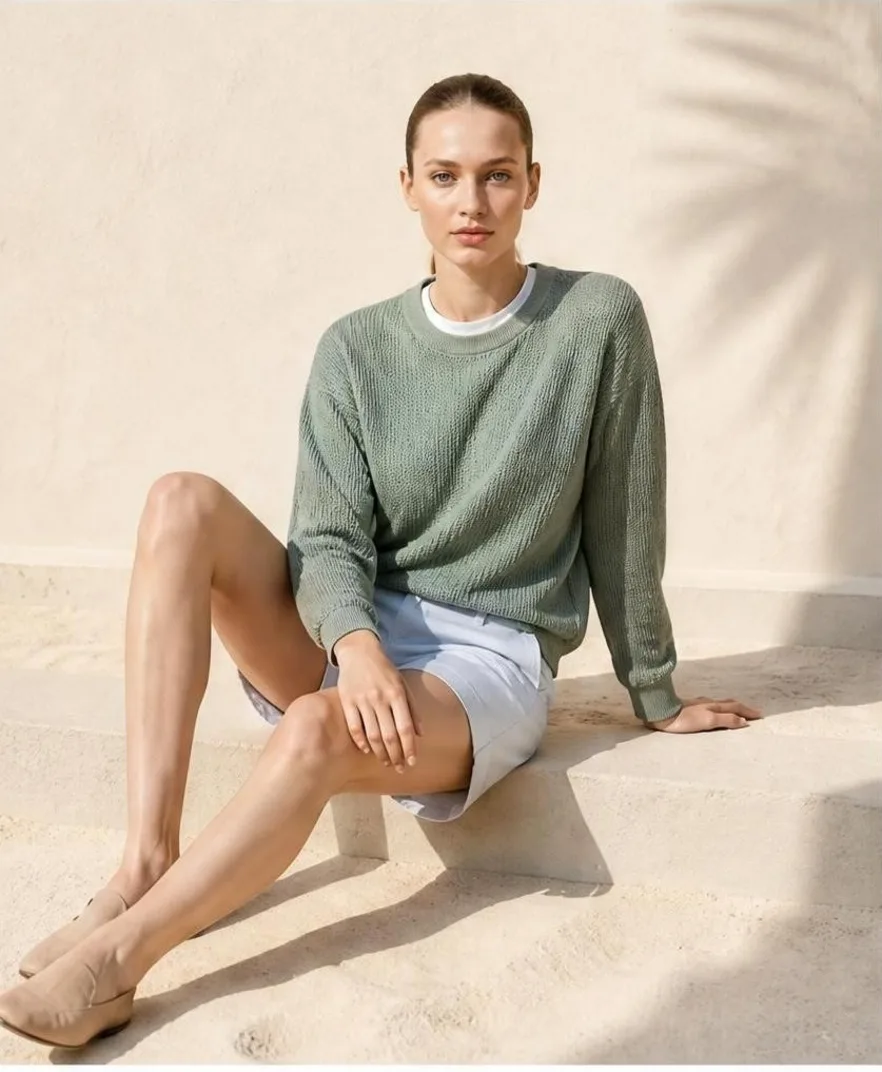
AI-generated with GridShot.
Strong image, wrong job. The raised knee and the sweater hem cover most of the shorts, the fabric folds where it is compressed, and the visible hem line has ridden up the thigh. Anyone judging length from this frame would guess several centimetres short. We keep shots like this for lookbook and social slots and never as the first product image. This is also the clearest illustration of why a run returning 16 to 25 pose variations is useful: you pick the pose that answers the question and let the rest be styling.
Daylight, waistband legible
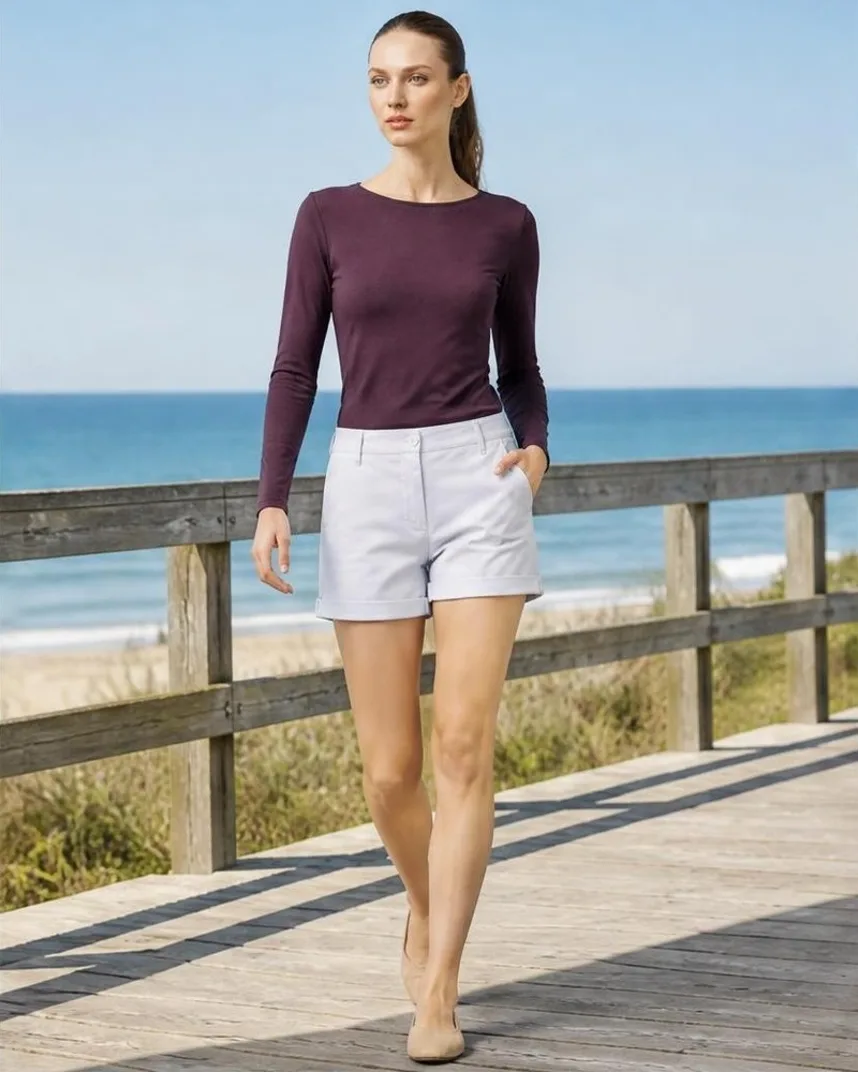
AI-generated with GridShot.
This frame carries what the first one lost. The fitted top leaves the waistband exposed, so belt loops, the closure and the front pocket openings are all readable, and the turn-up survives bright light instead of blowing out into white. The trade is in the pose: mid-stride, the leading leg lifts the hem and the trailing leg is partly hidden, so this is a rise and detail image rather than a length image. A front standing shot plus one like this covers a pair of shorts properly.
Where AI Shorts Still Fail Today
- An image cannot prove an inseam. A generated photo can show that the hem falls well above the knee. It cannot establish that the inseam is 13 centimetres. That is the size chart, and no imagery of any origin replaces it.
- Model proportions shift the reading. The same shorts on a longer-legged generated model look shorter. Keep one model for a category so length comparisons across your catalogue stay honest.
- Waistband construction gets smoothed. Elasticated backs, inner drawcords and pocket bags are inside-the-garment details that generation tends to simplify away. Photograph them or leave them to the description.
- Cuffs can lose their edge in bright light. On white and pastel shorts a turn-up can dissolve into the surrounding fabric. Check the hem specifically on pale colourways.
- Back-side artwork drifting forward. As in every category, a print or embroidery that belongs on the back can appear on the front. Back views need a human check before publishing.
- A person can leak in from a worn reference. If your fit reference shows the shorts on someone else, traces of that person can carry into the output. The pipeline separates identity from fit deliberately, but the separation is not absolute.
Related Category Guides
The same approach for neighbouring categories: jeans photography, where the hem meets the shoe instead of the knee, and knitwear photography, where the stitch rather than the length is the hard part. Shorts are also a seasonal category, which makes the planning question worth reading in how to plan a lookbook shoot. Finished output across categories is on the examples page.
Frequently Asked Questions
How do I make the inseam length credible in a photo?
Standing, full length, front, with the hem and the knee both inside the frame. That is the only composition in which a viewer can judge the distance between them. Everything else — seated, cropped, three-quarter — moves the hem relative to the knee and turns a length statement into a guess. Put the detail crops in the alternate slots, never in the first one.
Why is a seated shot a bad main image for shorts?
Because sitting rides the hem up the thigh and folds the fabric, so the visible length is shorter than the garment actually is. Our own seated example shows this clearly: the knee and the sweater hem cover most of the shorts. Seated frames belong in lookbook and social slots, where atmosphere matters more than measurement.
Can AI hold the difference between a short and a mid-length chino short?
Only if you tell it which one it is. Curated length values on the article are treated as brand truth and appear in the prompt as binding instructions; without them, an AI-detected value or a statistical average fills the gap, and averages land in the middle of the category. For a range that sells several inseams of the same style, curating the length is the difference between three products and three variations of one.
Which views does a pair of shorts need on a product page?
Four: standing full-length front for the length, a back view for the seat and back pockets, a waistband detail for the closure, and a hem or cuff detail. A side view is worth a fifth slot when the leg opening is wide or the shorts are cut with volume. Note that the front view often cannot carry the waistband, because the top covers it.
Do generated model proportions change how long the shorts look?
Yes, and it is worth planning around. Longer legs make the same inseam read shorter, which is the same effect real photography has with a different model. The practical answer is consistency: use one model for a category so that customers comparing two articles in your shop are comparing garments rather than bodies.
Ready to try it yourself?
Start with your own garment photos. Image generation is charged to your GridShot balance.
Create an account