AI vs Traditional Product Photography: A Comparison
The Short Answer
These two are not competing for the same job. A camera is the only way to get the first honest frame of a garment nobody has photographed yet, and the only way to shoot campaign work with real people. Generated photography covers what comes after that first frame: the second angle, the fourth colourway, the on-model view of an article that so far exists only as a packshot. Brands that use both end up drawing a line somewhere through their catalogue, and the useful question is not which approach wins but where that line belongs.
What follows compares them along the six dimensions that actually move the line — cost per image, lead time, iteration, usage rights, consistency across a collection, and where each one hits a wall.
The Comparison at a Glance
| Dimension | Traditional shoot | Generated from existing photos |
|---|---|---|
| Cost per image | A fixed block per shoot day, spread across however many articles get through it | USD 1 per published image plus a few cents of compute, no subscription |
| Lead time | Weeks, dominated by sample logistics, scheduling and the retouching queue | 5 to 15 minutes per run; selection and sign-off remain the human part |
| Iteration | Decisions are made before the shoot; changing your mind means another day | Decisions are made on finished images; changing your mind means another run |
| Usage rights | Photographer licence plus model release, each with channel, territory and expiry limits | No release for a synthetic person, but provider terms and AI Act transparency apply |
| Consistency across the collection | Drifts across weeks: changing light, changing models, changing framing habits | Holdable — but only when model, framing, light, fit and length are steered explicitly |
| Hard limit | Cost and calendar; the long tail rarely justifies a booking | Needs a usable source photo; the packshot stays a camera job |
Cost per Image: Two Different Shapes
The difference is less in the number than in how the number behaves. A shoot day is a fixed block: photographer, studio, model, styling and retouching are paid whether ten articles go through the day or twenty. The per-image cost therefore falls the more you batch, and a single reshoot is disproportionately expensive.
As a market observation rather than a survey, studios and freelancers in the German-speaking market publicly quote roughly EUR 15 to 25 for a finished e-commerce image in summer 2026, with individual quotes above and below that. The breakdown by service type is in product photography pricing, the anatomy of a shoot budget in fashion photoshoot costs.
Generated imagery prices per output instead: with GridShot a published image costs USD 1 plus the compute the run actually used, a few cents, with no subscription and no minimum term. New accounts start with USD 10 of credit. A run also costs USD 1, credited toward the first image you deliver from it, so only runs you never deliver from keep their dollar. The planning consequence matters more than the price — the eleventh image of an article costs what the first one costs, so there is no catalogue size at which the back view stops being affordable. In traditional production that is exactly the image that gets cut.
Lead Time: The Shoot Day Is Not the Bottleneck
A traditional cycle runs in weeks, and the shooting is the shortest part of it. Samples have to be picked, shipped, pressed and returned; a date has to suit photographer, studio and model at once; one shoot day produces more raw material than retouching clears in a week. Miss the date and the next one is not tomorrow.
A grid run takes 5 to 15 minutes and returns 16 to 25 pose variations. Runs are started rather than waited on, so compute time is not the planning-relevant number — selection and approval are. What disappears is the physical logistics in front of the shoot. What does not disappear is the person who has to look at every image before it goes live.
Iteration: Deciding Before Versus After
With a booked shoot, most decisions have to be right in advance. Background, styling, pose language and framing are fixed on the day, and changing your mind afterwards means another day. That pressure is why shot lists get conservative — you shoot what you already know works.
Generated production inverts the order: a run returns a grid of variations, and the choice happens on finished images rather than in a briefing. The same cardigan against a darker background, in a different pose, or framed head to toe rather than to the knee is a new run, not a new production. The benefit is not that experimentation is free — every published image still costs a dollar — but that being wrong is cheap to correct.
Usage Rights: The Dimension Most Comparisons Skip
Photographic images arrive with a licence, and the licence has edges: which channels, which territories, how long, and whether paid media is included. Model releases carry their own term, and when one expires the image has to come down even though the file still works.
Generated imagery removes the release question for a synthetic person but not the paperwork. Read what your provider's terms grant for commercial use, and keep track of which reference photographs went into which output — a worn reference showing a real person is precisely where an identity can leak into a result. Since 2 August 2026 the transparency obligations under Article 50 of the EU AI Act have applied to deployers, which includes brands publishing AI-generated images; how you implement that belongs with your legal advisors.
Consistency Across the Collection
Across 20 articles, inconsistency is invisible. Across 500 it becomes the visible quality of the category page: mixed crops, shifting skin tones, some articles head to toe and some from the hip up. Traditional production drifts for structural reasons — a catalogue photographed over several weeks passes through changing daylight, different models and slowly changing framing habits.
Generated production can hold that steady, but only when it is steered: model identity across the catalogue, a fixed framing rule per product group, unchanging light and background, and deliberate handling of fit and length. The last is where the methods differ most. In GridShot, curated length and fit values maintained by the brand take precedence over whatever the image analysis inferred, and existing worn photographs act as visual fit anchors for length, drape and silhouette while the identity of the person in them is discarded. Fit stops being something you hope for on the day and becomes an input value.
Three of Our Own Results, With Commentary
All three were generated with GridShot from product photography. We are showing what they get right and what they do not, because a page of hero shots proves nothing.
The catalogue case
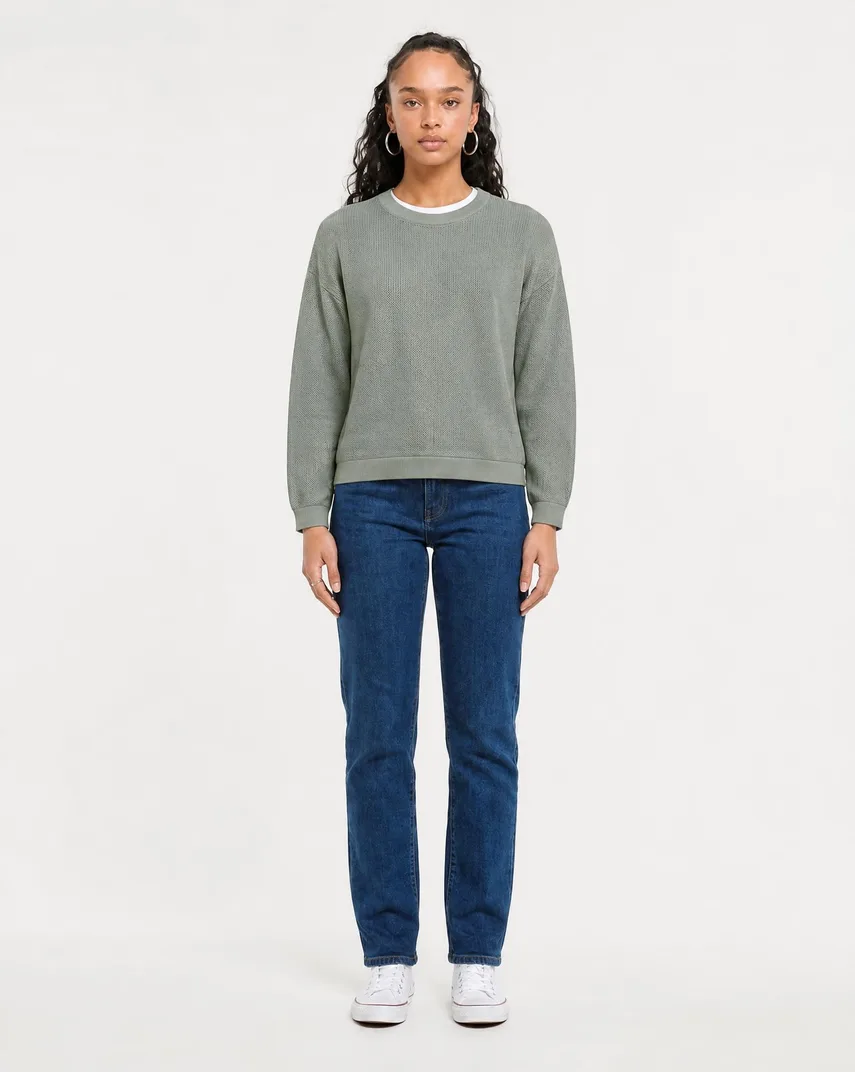
AI-generated with GridShot.
This is where the comparison is genuinely close: clean light, plain background, head to toe, the hem break visible inside the frame. On a product page it does the job a booked studio hour would have done. What it does not replace is the packshot — the garment alone on pure white, which several marketplaces require as the catalogue view — and it says nothing about the back of the sweater. Both are separate images, and one of them is still a camera job.
The setting a shoot would have to travel to
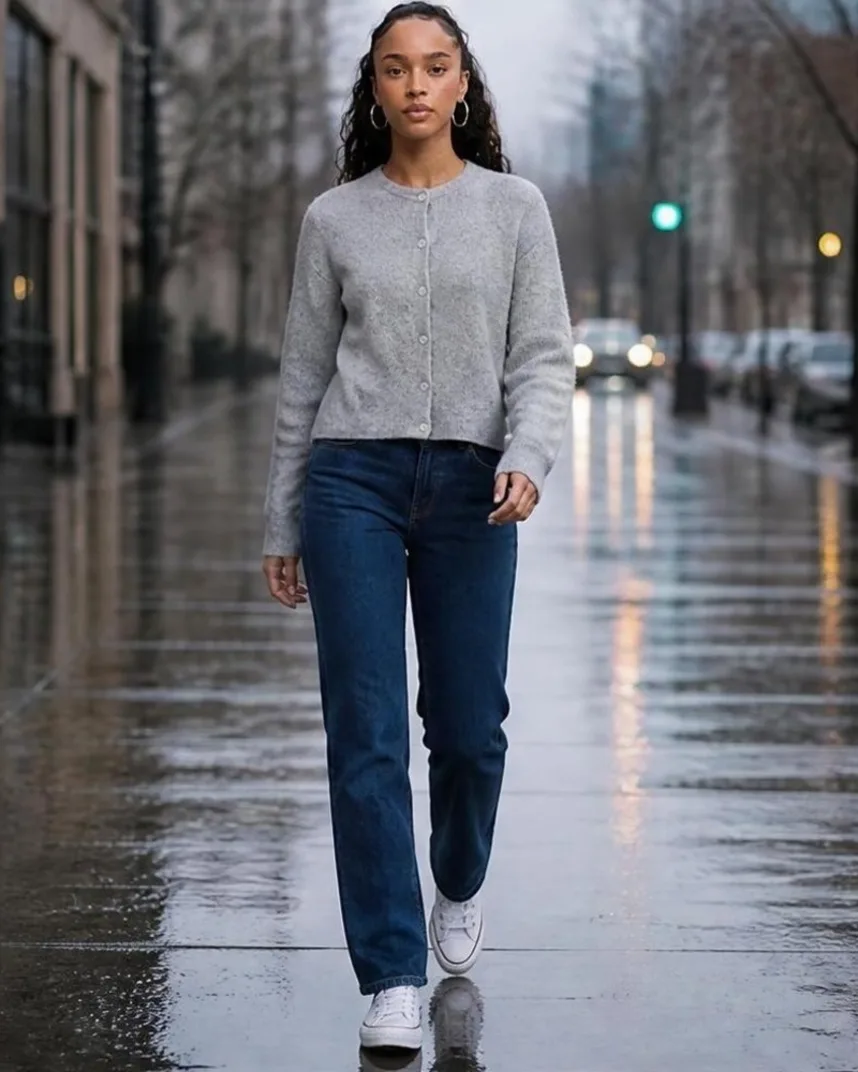
AI-generated with GridShot.
A wet city street in flat, overcast light. Traditionally this is a location, a permit, a weather window and a crew — the reason lifestyle imagery usually stays reserved for hero products. Here it is a second run on the same article. The honest cost sits in the surface: compare the cardigan with the next image and the brushed fibres flatten out, so the cut and the length read clearly while the material does not. Texture gets sold on a bright frame.
Where the limits show
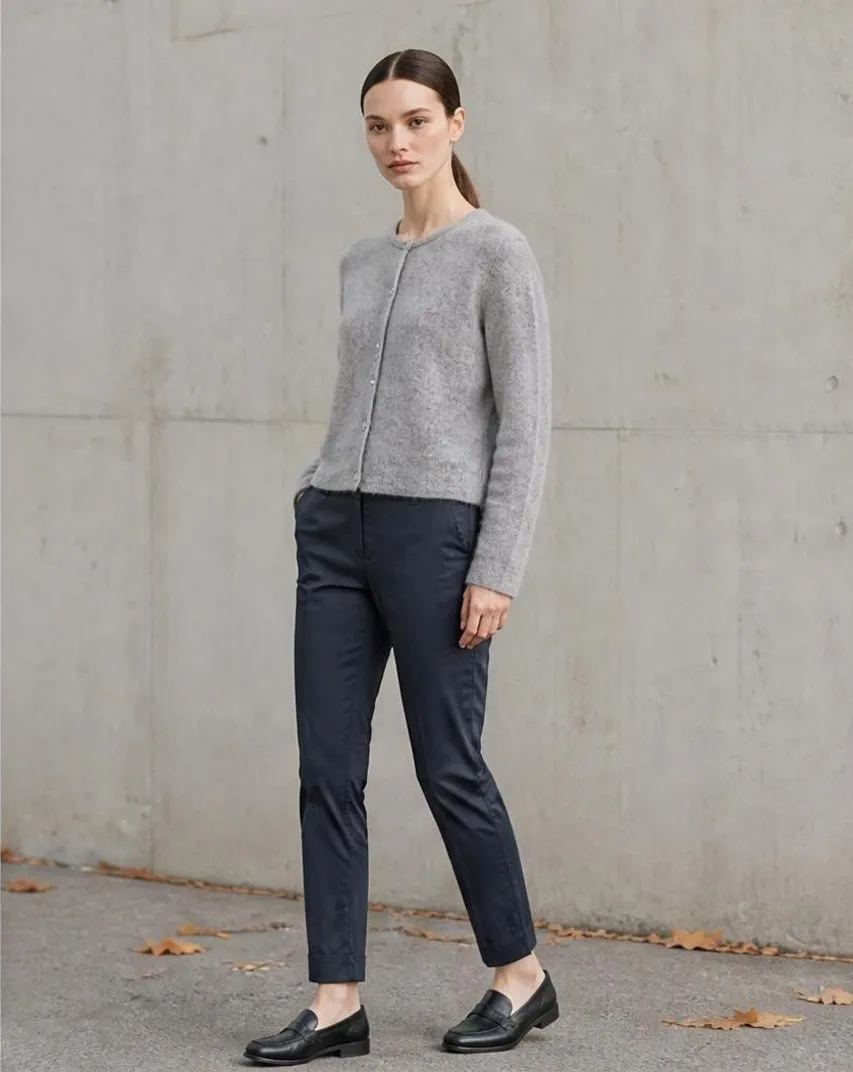
AI-generated with GridShot.
Against flat concrete the brushed yarn separates from the background and the cardigan reads as soft rather than as grey cloth, and the buttons sit evenly along the placket, which is not guaranteed at this scale. The flaw is the pose: the hand in the pocket pulls the front open and lifts one side of the hem, so this frame cannot be used to judge where the cardigan ends. That is the general shape of the limit. Small hardware, exact material and precise length need either a careful run or a photographed close-up — at full-length scale a button is a few pixels wide whichever way the image was made.
Where the Line Falls in Practice
The split follows from the job rather than from a ratio:
- Stays with a camera: the first frame of an article nobody has photographed, the compliant packshot on pure white, campaign and editorial work, motion and video, anything with a real brand face, and material that has to be seen to be believed — sheer fabrics, sequins, leather patina, iridescent colour.
- Moves to generation: on-model views of articles that already have a product photo, alternate angles and poses, colourway coverage, lookbook and lifestyle variants, seasonal restyling of existing pieces, and the long tail that never justified a studio booking.
Two things sit outside that split. Marketplace formats are a step after generation, not a property of it — cropping to Zalando's 1:1.44 or meeting Amazon's white-background rule happens in your own pipeline, and the requirements are collected in the marketplace image guidelines overview. And the layer that pays first is rarely the bestseller, which usually has good photography already, but the articles that never made it into the studio at all; scaling product photography works through that at catalogue scale.
To place the line in your own catalogue, list the articles missing an on-model view, check that each has a usable source photo, and take one product group through the entire pipeline — run, selection, sign-off, upload back to the shop — before deciding anything about the rest. Then compare against the real alternative, which for most of a catalogue is not an ideal studio day but the images you would otherwise never have produced at all.
Frequently Asked Questions
Is AI product photography good enough for e-commerce listings?
For catalogue breadth — alternate angles, colourways, on-model views of garments you have already photographed — it generally is. Where it still struggles is material you have to see to believe: sheer fabrics, sequins, leather patina, iridescent colours and unusual construction. It also needs an existing product photo to work from, so the first frames of a new article still require a camera.
Do I have to label AI-generated product images in the EU?
The transparency obligations under Article 50 of the EU AI Act have applied since 2 August 2026, with no transition period for deployers — which includes brands publishing AI-generated images. The 2 December 2026 date that circulates covers something narrower: machine-readable marking under Article 50(2) for systems already on the market before August. Treat the specifics as a question for your legal advisors.
Can AI photography replace a photographer entirely?
No, and the brands getting the most out of it do not try. Campaign imagery, motion and video, and anything featuring a real brand face — a named ambassador, your founders, the people in your store — stay with a camera. What shifts is the repetitive catalogue layer: the fifth angle, the seventh colourway, the on-model view of a product that already exists.
How long does it take to get a usable AI image?
A grid run takes 5 to 15 minutes and returns 16 to 25 pose variations to choose from. The slow part is human: selecting, checking fit and fabric against the real garment, and re-running the articles that did not land. How many runs a given article needs depends on the source photo and the category, which is why we publish no average.
How is AI photography priced compared with a shoot day?
A shoot day is a fixed block of cost whether you get through ten articles or twenty. Most vendors in this market sell monthly plans; GridShot bills per output instead — USD 1 per published image plus a few cents of compute, no subscription, USD 10 of starting credit. A grid run also costs USD 1, credited toward the first image you deliver from it, so only runs you never deliver from keep their dollar.
Ready to try it yourself?
Start with your own garment photos. Image generation is charged to your GridShot balance.
Create an account